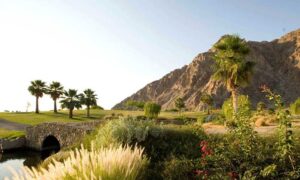
SilverRock Resort in La Quinta, CA, an Arnold Palmer design set at the base of the Santa Rosa Mountains, renovated the front nine holes this summer with Latitude 36® Bermudagrass. The city-owned course is known for firm, fast conditions and true greens, and has turned to improved warm-season grass to strengthen playability in the desert.
Helping manage the renovation is superintendent Chris Hoyer, who is in his fourth year at SilverRock and his 17th managing grass as a superintendent in the desert. A University of Wisconsin–Madison turf and soil science graduate, Hoyer has overseen multiple Southern California courses and brought that experience into SilverRock’s evaluation process when the need for new grass became clear.
Originally planned as part of a larger resort development, SilverRock stands today as a city-owned golf course. That stability has allowed the city and course team to invest in long-term solutions such as the recent Latitude 36® conversion.
SilverRock was built in 2004 and originally grassed with TifSport bermudagrass. Hoyer described it as a good Southeast variety that was slow growing and not too aggressive, but over time it struggled to recover after overseeding. “So after 20 years of overseeing this grass it was to a point where it was not even coming back. We would have to sod acres every summer for our bermuda to fill in in the summertime,” he said.
Once they started to receive negative reviews from players, SilverRock knew a change was needed. In summer 2024, the team started a trial with three bermudagrass varieties: Latitude 36, Coachella and TifTuf on a single hole. Each grass covered one-third of the fifth hole so golfers could unknowingly compare them side by side. Hoyer explained they get a lot of repeat city residents that get a discount to play at the course and while they didn’t know the grass types they knew they were leaning towards Latitude 36.
Hoyer said the trial wasn’t only about short-term playability but also about long-term trends in desert golf. With new bermudagrass varieties showing stronger color retention and cold tolerance, he saw a chance to reduce or even eliminate overseeding. “That was the main deciding factor. Just better playability, better growth habits, and again, the possibility of not overseeding in the future,” he said.
Trialing Latitude 36®
The one-year trial began in June 2024, with all three grasses sprigged and grown in within six weeks. Hoyer said they reopened the hole in late summer and did not overseed through the winter, allowing them to observe performance across color retention, traffic tolerance and recovery.
A couple of factors ultimately set Latitude 36 apart. “The two factors that really sold me on the Latitude 36 versus the TifTuf was when we got about a week of frost and at that point it finally went off color but it wasn’t more than about two and a half weeks and it was back to a green color whereas the other two varieties were not,” Hoyer said.
The other key advantage came in the spring. While all bermudagrasses produce seed heads, Latitude 36 was far less noticeable. “The Latitude seed heads were minute to where you could barely even notice it was seeding out,” Hoyer said.
He described the stems as very fine and leaf-like compared to Coachella and TifTuf, which produced larger seed heads that turned fairways and rough almost white. With Latitude 36, the seed heads mowed out quickly without leaving stems or dulling the grass’s bright green color. “They’re very unnoticeable.”
Versatility and Recovery
Hoyer also highlighted Latitude 36’s versatility across mowing heights compared to the other two grasses. In his trial, he cut the grass from 2 inches to one-tenth of an inch and saw consistent performance at every level, from rough to green surrounds. “Latitude 36 can go down to almost green height, which, for us as a superintendent, when we’re looking to increase playability or even challenge golfers, we mow things lower so that it plays faster and firmer,” he said.
He pushed the trial further by rapidly changing the height of the cut and almost scalping the grass to test recovery. “Latitude’s recovery process was way faster than the other varieties,” Hoyer said.
Hydrosprigging Success
This summer marked Hoyer’s first time hydrosprigging grass, though he had hydroseeded wildflowers before. Two summers ago, they mechanically hand-spread sprigs, cut them in and then rolled them in and saw great establishment, but noted it required more water. The sprigs were applied at 350 bushels per acre through a hydrotruck mixture with fiber mulch and starter fertilizer. “It had everything we needed for that plant right there available for it to be established,” Hoyer said.
He noted hydrosprigging allowed the course to stay at finished grade without saturating the soil, which reduced rutting and grading issues. The fresh sprigs stayed green and viable throughout the process, leading to quick establishment and a higher success rate than mechanical methods.
Since planting in late June, Hoyer has been impressed with Latitude 36’s establishment and growth. Despite lower humidity than usual, the grass responded well, spreading faster when drier. “I found the Latitude 36 would have the tendency to spread and creep faster when it was dried down a little bit. If I provided more water, thinking that’s what it needed to spread, it was almost counterintuitive. If I let things dry, it would spread more, which was very interesting to me.”
The team also noticed a finer texture compared to other varieties, with standout color. “You could almost look at the Latitude 36 in late summer and think it was overseeded with ryegrass because of its color.”
Evergreen Turf Partnership
Hoyer credited Evergreen Turf, led by president Jimmy Fox, with playing a key role in the project’s success. Introduced through other desert superintendents, Fox educated him on improved grass varieties and brought him to the farm to see Latitude 36 firsthand. Hoyer called the sprigs among the best and freshest in his 17 years in the desert.
He also appreciated the Evergreen team’s consistent on-site presence during the trial and installation. “He was very, very personable about wanting to be successful and wanting us to be successful,” Hoyer said. Evergreen set aside an entire field of Latitude 36 for SilverRock, ensuring the sod and sprigs were clean and uniform. “All of our sod and sprigs came from that field and it was all clean. It was perfect. There were no rocks in the sod rolls and they were here all the time.”
Even when sprigs looked fine to Hoyer, Fox replaced multiple boxes with fresher material from the farm. “The services that these guys have provided and the quality of the grass are hands down second to none,” Hoyer said.
Results and Next Steps
SilverRock is now wall-to-wall Latitude 36 on the front nine, except for the greens and they’re leaving the fifth hole as a trial to continue monitoring the three varieties for performance and water efficiency.
Hoyer is optimistic about what Latitude 36 could mean for desert golf. “I can’t wait for it to be the next big thing in the desert Southwest. I would love for it to become a grass that holds through winter and eliminates the overseed process and reduces the water usage here in the desert,” he said. With 120 courses in the region, he sees the potential impact clearly, knowing how much he uses for 75 acres of grass.
“There are other places that have 400–500 acres of grass so if we can come up with something that’s proven, will work and hold true through the wintertime, I think it’s a win-win. Revenue can go up for the clubs, expenses will go down and you have year-round instead of being shut down for the month of October and your turf is marginal at best come June and July.”
The course reopened in late August with positive early results, and once approved, the city is expected to move forward with a Latitude 36 renovation of the back nine.
Discover Desert Golf at SilverRock
Explore Latitdue 36® for Your Course
This article was written by Sod Solutions Media and Content Manager, Cecilia Johnson. To read this article online and view all photos, click here. Based in Charleston, SC, Sod Solutions has spent over 30 years developing and releasing leading turfgrass varieties including Palmetto® St. Augustine, Celebration® Bermudagrass and EMPIRE® Zoysia. A trusted source for turfgrass news and insight, Sod Solutions is available for media opportunities or expert commentary. Visit SodSolutions.com or follow @SodSolutions on social media or to learn more. For inquiries or visuals, contact cecilia@sodsolutions.com.